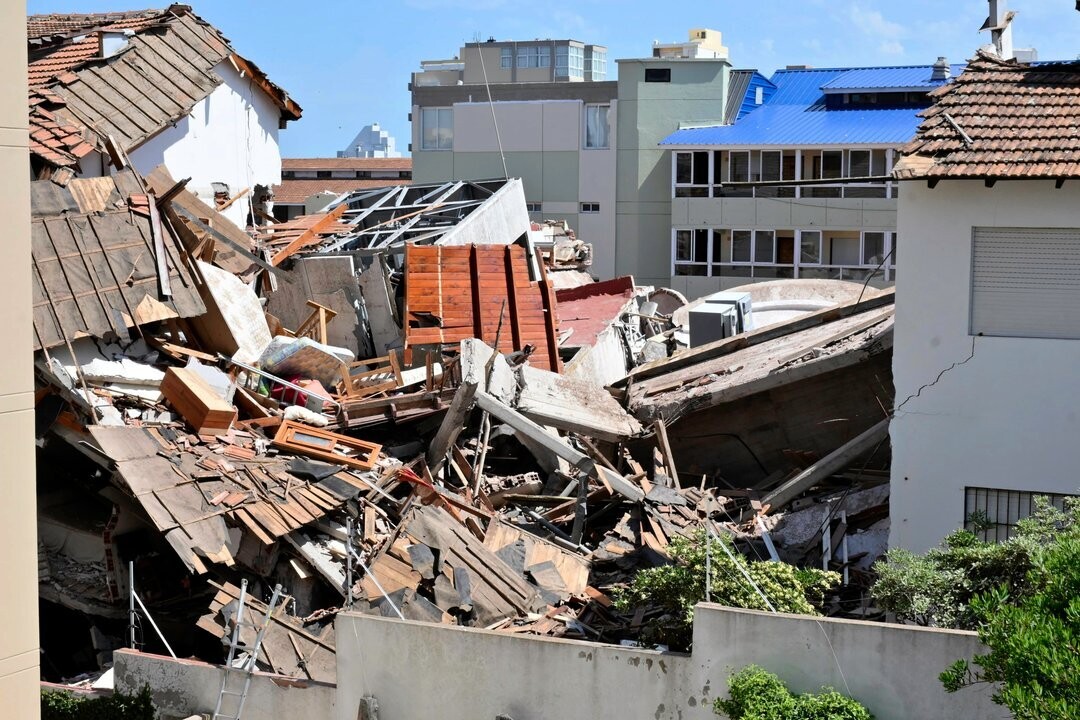
Buenos Aires, April 3 (NA) -- An expert report by architect Enrique Bonavita, the accused party, was incorporated into the case file of the collapse of the Apart Hotel Dubrovnik in Villa Gesell, which resulted in nine deaths in October 2024. The report indicated that the outcome was "predictable and preventable," while detecting failures in key columns, construction irregularities, and a lack of controls. The document, accessed by the Argentine News Agency, also indicated the possible existence of administrative liabilities for approving the work under deficient conditions. Collapse of the Apart Hotel Dubrovnik in Villa Gesell. Photo: Agency NA (Jose Scalzo) The case continues under investigation, as the families of two victims and other owners are represented by the law firm of Graciela Bravo, acting as a private complainant, while the justice system advances with expert assessments and complementary analyses. In this vein, the lawyer stated that "the expert for the defense maintained that the damage derives from pre-existing structural deficiencies of the building," however, she countered: "It is predictable that Bonavita's defense will attempt to use this report to disclaim responsibility and attribute the damage to pre-existing structural defects. Thus, they attempt to break the causal link and disclaim responsibility." "From the argumentative development of the expert report itself, the existence of multiple internal contradictions, logical dislocations, and the assertion that the structural survey was 'precise, but random' can be inferred," Bravo concluded based on the text. In parallel, a technical annex incorporated into the file, prepared by experts from the Fire Department's Accident Investigation Division, indicates that at the time of the collapse, the building was under construction, with work on replacing carpentry in 48 balconies and tasks on the ground floor, in addition to documentation accounting for the modernization of the elevator. However, the defense's report (Bonavita's) indicates that the change of use of the property, from multi-family housing to an apart hotel, did not, by itself, imply a significant increase in structural overloads, and after the collapse, no generalized corrosion processes or settlements in the foundations were detected. As a technical detail, the expert report indicated that the wind conditions at the time of the collapse would have been around 24 kilometers per hour, values contemplated in the current regulations, and that there is no prior documentation on cracks or structural deformations before the collapse. Likewise, one of the images shows, in the wreckage of the construction, columns "B5" and "C5", sections that were above the second basement, which "collapsed almost vertically," which implies that they did not tilt or fall to the sides, but rather gave way and fell practically straight down in a straight line.